November 7, 2024 - Andrew Cook
The Paradox of Motion: Finding Peace at Speed
On the soul-healing nature of riding motorcycles—where relaxation meets intensity, and constant improvement becomes meditation.
There's something fundamentally contradictory about the experience of riding a motorcycle that makes perfect sense the moment you twist the throttle and lean into the first corner. It shouldn't work, this combination of absolute presence and total release, of calculated risk and meditative calm, yet there it is—mile after mile, curve after curve, a reminder that the best things in life often exist in the tension between opposites. When people ask me why I ride, I could give them the easy answers about freedom or adventure, but the truth is more nuanced than that, more interesting. It's about finding that rare space where relaxation and intensity aren't just compatible but somehow necessary parts of the same experience, where the act of pushing yourself becomes the very thing that centers you.
The physics of it all is deceptively simple. Lean the bike, apply throttle, look through the turn to where you want to go. But between those mechanical actions and the reality of carving through a mountain pass or threading your way down a coastal highway, there's an alchemy that transforms the rider. Every twist of road demands your complete attention, not in the frantic, scattered way that modern life usually extracts it, but in a focused, almost meditative intensity. Your mind empties of everything except the immediate moment—the feel of the bike beneath you, the reading of the road surface, the calculation of entry speed and line choice, the million tiny adjustments that happen faster than conscious thought. It's the opposite of the anxiety-producing multitasking we're all drowning in. On the bike, there's just the task at hand, and paradoxically, that singular focus becomes the most relaxing thing you'll do all week.

What makes it particularly compelling is that the stakes aren't theoretical. The consequences of inattention are real and immediate, which forces a kind of honesty with yourself that's rare in daily life. You can't fake your way through a tight decreasing-radius turn or pretend you're more skilled than you are when the road suddenly goes from smooth to gravel-strewn. The bike doesn't care about your ego or your excuses—it responds only to what you actually do, not what you meant to do or what you think you're capable of. This ruthless objectivity becomes a teacher if you let it, constantly pushing you toward genuine improvement rather than the performance of competence. Every ride is a lesson in humility and growth, a reminder that there's always another level of skill to reach, another refinement to make, another way to read the road more accurately or carry more speed more smoothly through a section you thought you'd mastered.
The improvement itself becomes addictive, not in the toxic way that ambition usually manifests in modern life, but as a more sustainable form of self-development. You're not chasing some arbitrary metric or competing against anyone but your past self. You're simply getting better at something that matters to you, incrementally refining technique, building muscle memory, developing instincts that eventually become second nature. Trail braking becomes less of a conscious decision and more of an automatic response. Your body learns to weight the pegs correctly, to shift your hips smoothly, to use your core for stability. What once required deliberate thought becomes fluid motion, which opens up mental space to focus on the next level of challenge. It's the kind of skill acquisition that our brains are actually wired for, the satisfaction of mastery earned through practice and attention rather than purchased or inherited.
But here's where it gets interesting, where the whole experience transcends the merely technical and becomes something closer to spiritual—though I'm wary of that word and its tendency to obscure rather than illuminate. When you're riding well, when everything clicks and you're flowing through a series of corners with the kind of precision that feels almost effortless, something shifts in your relationship to the world around you. The boundary between you and the environment becomes permeable in a way that's hard to describe but impossible to forget once you've felt it. You're not observing the landscape from behind a windshield, insulated by climate control and the sealed cabin of a car. You're in it—feeling the temperature drop as you descend into a valley, smelling the pine trees or the salt air or the rain that's coming, sensing the change in humidity, experiencing the world directly rather than through the mediated comfort of modern transportation.

This exposure, which should theoretically make you feel vulnerable, instead creates an odd sense of connection and belonging. You become part of the ecosystem you're moving through rather than a separate observer. The wind isn't just something happening around you—it's pushing against your chest, buffeting your helmet, something you have to account for and work with. The road surface tells you stories through the handlebars and footpegs—the gravel that's washed onto the inside of this corner, the tar snakes that could upset your traction, the slight crown in the road that affects your line. Weather isn't an abstraction you check on your phone; it's immediate and consequential, something you feel in your bones and plan around. This forced awareness of natural conditions makes you pay attention in a way that modern life has trained us not to, makes you notice things that would otherwise remain invisible—the way light filters through tree cover, the smell of sage after rain, the exact moment when a marine layer starts to burn off.
There's a purity to this kind of travel that feels almost anachronistic in our current moment. No screens demanding attention, no notifications pulling your focus, no way to multitask or half-engage with the experience. Just you, the machine, and the road ahead—or the trail, if you're that kind of rider, the dirt beneath your wheels and the horizon in every direction. It's entirely analog in the best possible way, requiring your full physical and mental presence. Your survival depends on staying engaged, which paradoxically becomes the source of the deepest relaxation. Not the mindless relaxation of passive entertainment or the forced relaxation of vacation downtime, but the deeper calm that comes from being exactly where you are, doing exactly what you're doing, with no part of your attention wandering to past or future.
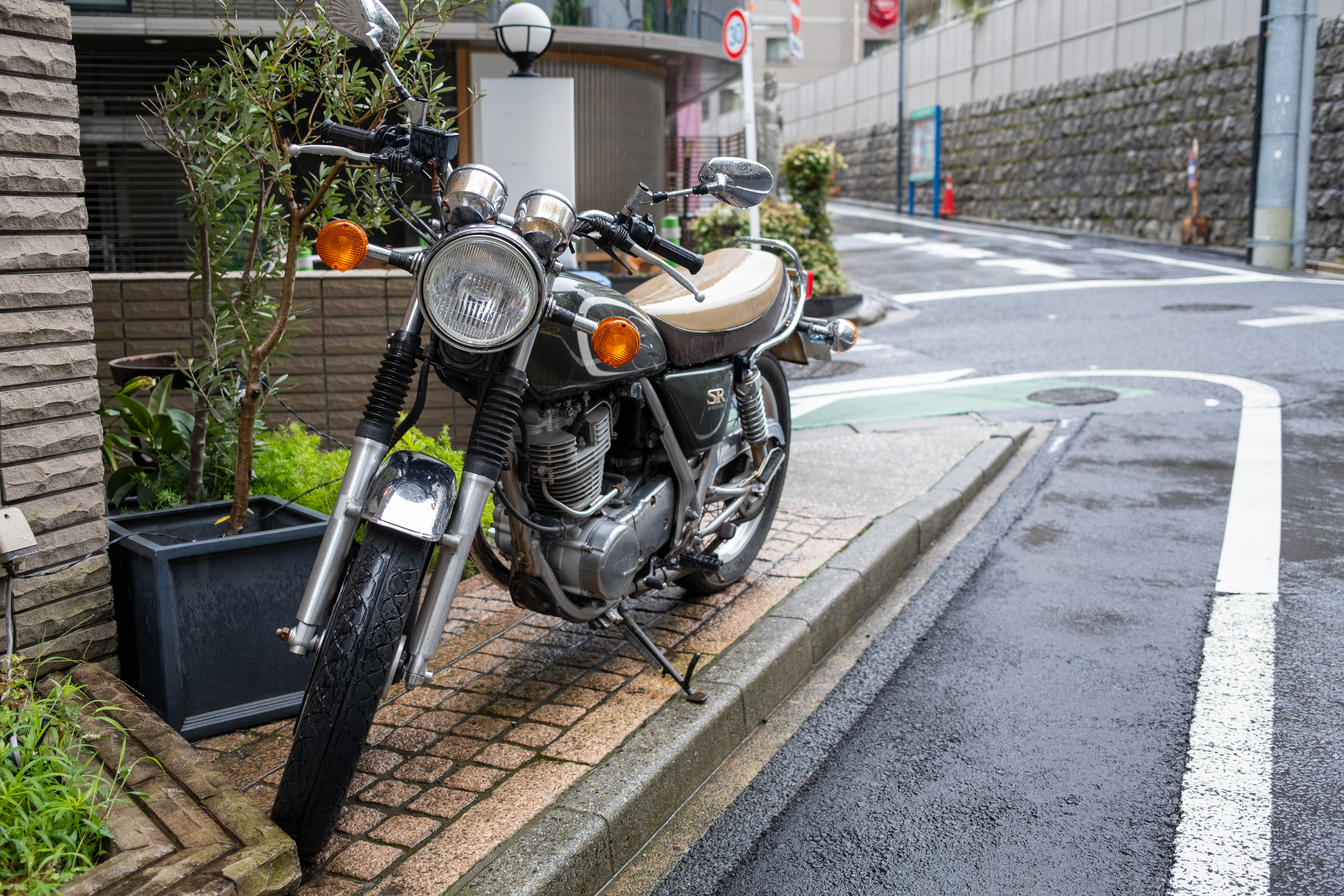
The living-on-the-edge aspect isn't about recklessness—though there's always that element available if you want it, that temptation to push harder than is wise, to carry more speed than the corner can really accommodate. But the meaningful edge isn't about pure speed or aggressive riding. It's about operating at the limit of your current skill, about finding that zone where you're challenged but not overwhelmed, stretched but not snapped. It's the same principle that makes flow states possible in any discipline, that sweet spot where difficulty and ability align to create complete engagement. On a motorcycle, you have the unique ability to calibrate this balance constantly, to back off when you're exceeding your skill or push harder when you're cruising too comfortably. The machine responds instantly to your inputs, creating a feedback loop between intention and result that keeps you honest about where you actually are versus where you think you are.
This ongoing negotiation with reality, this constant recalibration of risk and skill, becomes a form of active meditation. Your ego gets worn down by the simple physics of the situation—the bike doesn't care who you think you are or what you've accomplished in other domains of life. It only cares what you can actually do right now, in this corner, on this road, with these conditions. That clarity is brutal and beautiful, humbling and empowering in equal measure. You learn to drop the stories you tell yourself about yourself and deal with what actually is. And in that dropping, in that release of self-concept and the embrace of simple present-moment competence, something shifts. The anxiety that comes from trying to maintain a particular image dissolves. The stress of protecting your ego from damage falls away. What remains is just the task, just the riding, just the pure experience of movement through space.
The soul-healing aspect isn't immediate or obvious. It's not like you finish a ride and feel instantly transformed, though sometimes that happens too. It's more cumulative, more subtle. It's the way that consistent riding slowly rewires how you approach challenge and uncertainty in other parts of life. It's the confidence that comes from repeatedly facing situations that demand your best and discovering that you're capable of rising to meet them. It's the perspective that comes from regularly doing something where the stakes are real but the context is chosen—where you're voluntarily putting yourself in situations that require growth and adaptation, building resilience through practice rather than having it thrust upon you by circumstances beyond your control. It's the satisfaction of measurable improvement, of knowing that this season's version of you handles situations better than last season's version, not because of some abstract personal development program but because you've put in the hours and the miles and earned the skill.

And perhaps most importantly, it's the reminder that life is fundamentally about movement and change, about navigating through uncertainty with whatever skill and grace you can muster. Every ride is a small-scale rehearsal for that larger truth, a chance to practice being present, being capable, being responsive to conditions as they actually are rather than as you wish they were. The motorcycle doesn't let you coast through on autopilot or phone it in or pretend things are other than they are. It demands authenticity, presence, continuous adjustment—the same things that any meaningful life requires, but concentrated into pure form, immediate and undeniable. You can't argue with the physics. You can't negotiate with the corner. You can only show up, pay attention, and do your best to execute cleanly. And in that simplicity, that reduction of life to its essential elements, there's a clarity and peace that's increasingly rare in our complicated, mediated, overthought world.
So yes, it's thrilling—the acceleration, the lean angle, the speed, the way everything comes together when you get it right. But it's also deeply, fundamentally relaxing in a way that has nothing to do with passive rest and everything to do with complete engagement. It's the relaxation that comes from knowing exactly what you're doing and why you're doing it, from being competent at something that matters, from continuously improving at a skill that rewards precision and punishes complacency. It's the peace that comes from being fully alive in a moment that demands your full attention, from connecting with the natural world through direct experience rather than digital mediation, from feeling the wind and temperature and light as living forces rather than abstract data points. And it's the satisfaction that comes from voluntary challenge met with increasing skill, from pushing yourself not because you have to but because you've discovered that the push itself—the constant striving for improvement, the endless refinement of technique, the deepening relationship with machine and road and self—is where the real value lies. Not in arriving, but in the quality of the journey itself, mile after mile, curve after curve, finding peace at speed and calm in motion, discovering that sometimes the best way to relax is to lean in.